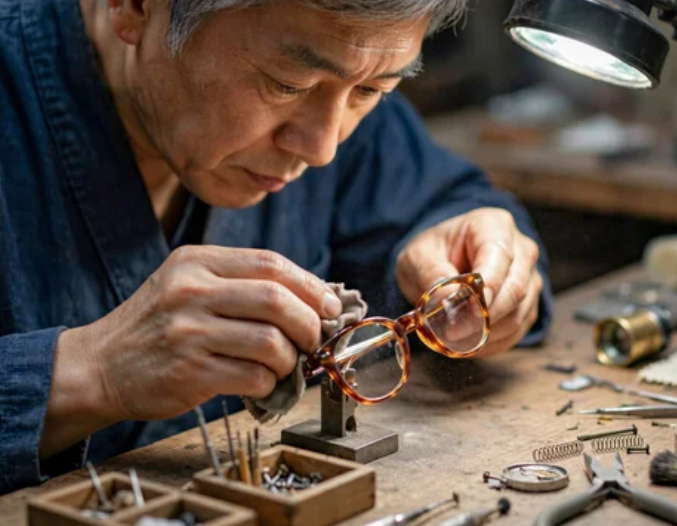
Japanese eyewear brands have a reputation that few other countries can match. Collectors and opticians around the world rank labels like Masunaga, Matsuda and Eyevan 7285 alongside the finest European frame makers, and in many cases above them. The appeal is a combination of meticulous handcraft, lightweight titanium engineering and a quiet, refined design language.
For Singapore buyers, Japanese frames have another advantage. Many are designed with Asian faces in mind, with nose pads and bridge shapes that sit comfortably on lower nose bridges. That makes them a natural choice for anyone who has struggled with heavy European acetate frames sliding down their face in the humidity.
This guide explains what makes Japanese eyewear special, profiles the best Japanese eyewear brands in 2026, and shows you where to buy authentic Japanese frames in Singapore.
💡 KEY INSIGHT
Most of Japan’s finest frames come from one small region: Sabae, in Fukui Prefecture. Over 95% of Japan’s eyeglass frames are made there, often passing through more than 200 separate processes before they reach the shop.
Quick Picks: Best Japanese Eyewear Brands (2026)
- Best overall heritage brand: Masunaga, Japan’s original frame maker since 1905
- Best statement luxury: Matsuda, with hand-engraved, jewellery-like detailing
- Best modern design: Eyevan 7285, with archive-inspired craftsmanship
- Best for Asian fit and comfort: 999.9 (Four Nines), famous for its flexible hinge
- Best contemporary handmade: Akoni, designed in Switzerland and made in Japan
- Best minimalist titanium: Kame ManNen
Why Sabae Is the Capital of Japanese Eyewear
The story of Japanese eyewear begins in 1905, when Gozaemon Masunaga, a local leader in Fukui, looked for a way to support farming families through the long, snowy winters. He brought frame-making craftsmen from Osaka and Tokyo to teach local workers, and eyewear became a winter trade for the region. That same company still makes frames today under the Masunaga name.
Over the following century, Sabae grew into one of the world’s three major eyewear manufacturing hubs, alongside Italy and China. Today, more than 95% of Japan’s frames are made in the Fukui region, by a cluster of around 250 companies and thousands of skilled workers.
Sabae’s defining breakthrough came in the early 1980s, when local makers developed the world’s first titanium eyeglass frames. Titanium is notoriously difficult to weld and shape, but it is light, strong and hypoallergenic. Mastering it gave Japanese eyewear the reputation for featherweight precision that it still holds.
What Makes Japanese Eyewear Different?
Titanium expertise
Japanese makers work extensively with pure titanium and beta titanium. Beta titanium is an alloy that is more flexible than pure titanium and springs back to shape, which makes temples comfortable and durable. Because titanium contains little or no nickel, it is a good choice for sensitive skin.
Hundreds of handcrafted steps
A typical Sabae frame passes through more than 200 processes, from cutting and soldering to polishing and assembly. Matsuda describes around 250 steps, and Eyevan 7285 cites around 400 processes per pair. Much of this work is still done by hand, by craftsmen with years of training.
Hinges and fine engineering
Details matter. Masunaga is known for multi-barrel hinges that keep temples aligned for years. 999.9 developed a patented reverse-curve hinge that flexes to fit the head without pinching. These small engineering touches are a big part of why Japanese frames feel so good to wear.
Polished acetate
Japanese makers also produce outstanding acetate frames. Matsuda, for example, hand-polishes its acetate over several days to achieve a deep, glass-like finish. If you are weighing materials, high-quality cellulose acetate is prized for its comfort, durability and depth of colour.
Inside a Sabae Workshop: How a Japanese Frame Is Made
Understanding the process helps explain the price. While each brand works differently, a typical premium Japanese metal frame goes through stages like these:
- Design and prototyping. Designers draw and refine the frame, and craftsmen build prototypes to test balance and fit.
- Pressing and cutting. Titanium wire and sheet are pressed, cut and shaped into rims, bridges and temples.
- Brazing and soldering. Components are joined using specialised techniques, because titanium cannot be soldered like ordinary metals.
- Grinding and polishing. Each joint is smoothed by hand so the frame feels seamless.
- Surface finishing. Frames are plated or coated, sometimes in several layers, for colour and durability.
- Assembly and inspection. Hinges, nose pads and temples are fitted, then each frame is inspected before leaving the workshop.
Acetate frames follow a different path, cut from blocks of material, shaped, fitted with core wires and polished in tumbling barrels and by hand. Many Sabae workshops specialise in just one or two steps, and frames travel between several specialist firms before they are finished. This division of skills is part of what makes the region’s quality so consistent.
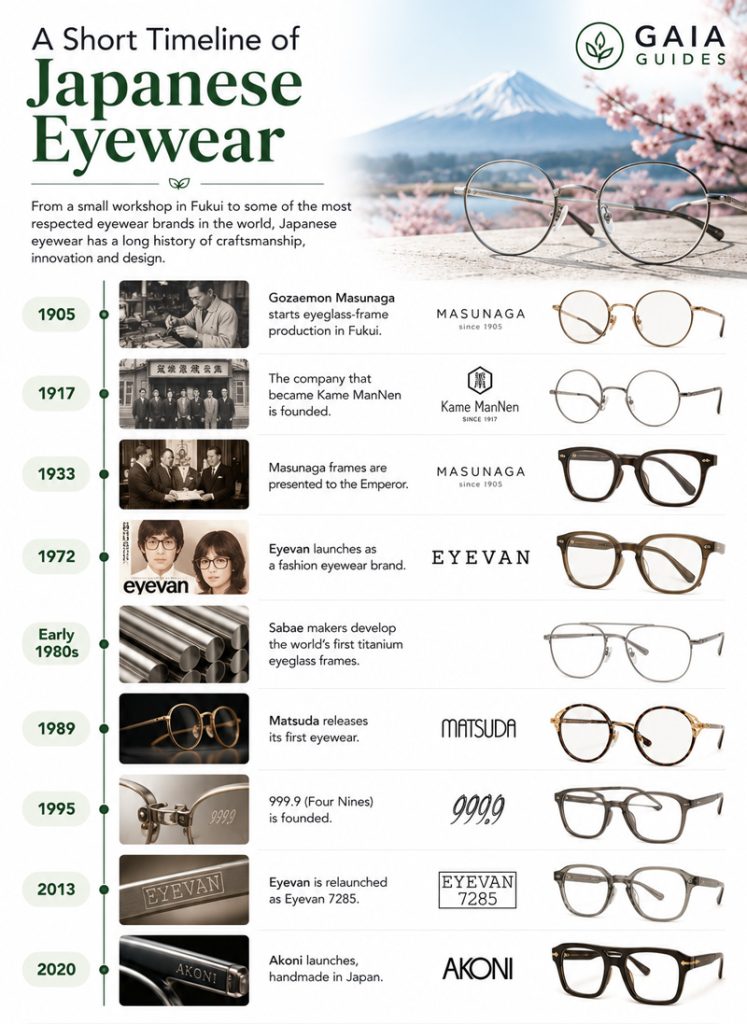
A Short Timeline of Japanese Eyewear
- 1905: Gozaemon Masunaga starts eyeglass-frame production in Fukui
- 1917: the company that became Kame ManNen is founded
- 1933: Masunaga frames are presented to the Emperor
- 1972: Eyevan launches as a fashion eyewear brand
- Early 1980s: Sabae makers develop the world’s first titanium eyeglass frames
- 1989: Matsuda releases its first eyewear
- 1995: 999.9 (Four Nines) is founded
- 2013: Eyevan is relaunched as Eyevan 7285
- 2020: Akoni launches, handmade in Japan
Japanese Frames as Prescription Sunglasses
Many Japanese frames work beautifully as prescription sunglasses, which are especially useful under Singapore’s strong year-round sun. Titanium frames stay comfortable in the heat, and classic shapes suit tinted, polarised or photochromic lenses. If you want one pair for indoors and outdoors, ask your optician about photochromic lenses that darken in sunlight.
The Best Japanese Eyewear Brands in 2026
⭐ 1. Masunaga: Best Japanese Heritage Brand
Score: 9.5/10
Founded in 1905, Masunaga is where Japanese eyewear began. More than a century later, the company remains family-led and still manufactures in Fukui. Its frames combine classic shapes with modern engineering: hand-polished Japanese acetate, titanium temples, rivet details and finely engineered hinges. The Masters of Craft (MOC) line is produced in limited numbers for collectors.
- Style: refined classics, from round and panto shapes to elegant metal frames
- Materials: Japanese acetate, titanium, beta titanium
- Best for: buyers who want timeless frames that will last for years
- Popular models: Lex, Radio City and Kenzo
Singapore buyers can see one of the larger Masunaga ranges at Masunaga stockist Visio Optical in Holland Village.
⭐ 2. Matsuda: Best Statement Luxury Frames
Score: 9.3/10
Matsuda was founded by designer Mitsuhiro Matsuda, whose fashion house dates back to 1967. The first Matsuda eyewear followed in 1989, and the eyewear line was relaunched in 2011 after his death. Matsuda frames are unmistakable: Gothic, Art Nouveau and Art Deco influences, hand-engraved metalwork, and jewellery-like detailing. Precious editions use materials such as sterling silver, with plating in gold, palladium or ruthenium.
- Style: ornate, avant-garde and collectable
- Craft: around 250 production steps, with hand engraving and multiple hand-soldered joints on metal frames
- Best for: collectors and anyone who wants frames as a statement piece
- Fit note: many models suit higher bridges, but some are well suited to Asian faces, so try them on
See the current range at the Matsuda eyewear Singapore collection page.
⭐ 3. Eyevan 7285: Best Modern Japanese Design
Score: 9.0/10
Eyevan launched in 1972 as one of Japan’s first brands to treat eyewear as a fashion item. In 2013, a new design team revived it as Eyevan 7285, drawing on the brand’s archives. Frames are made in Sabae and pass through around 400 processes per pair. Designs take inspiration from unexpected sources, from vintage cutlery to old eye-testing equipment.
- Style: understated, intellectual and highly detailed
- Best for: design lovers who prefer quiet luxury
- Where in Singapore: stocked by several independent opticians, including outlets of Optique Paris Miki and Eyewerks
⭐ 4. 999.9 (Four Nines): Best for Comfort and Asian Fit
Score: 8.9/10
999.9 was founded in 1995 by optical professionals who believed that “glasses should be fine tools”. The name refers to the purity of fine gold. Its signature innovation is a patented reverse-curve hinge that flexes to fit the head comfortably without pressure. Frames are designed with Asian faces and lower nose bridges in mind, making them one of the most comfortable Japanese brands for Singapore wearers.
- Style: clean, functional and precise
- Best for: all-day comfort and people who find most frames slip
- Where in Singapore: the brand has a store at Ngee Ann City on Orchard Road
⭐ 5. Akoni: Best Contemporary Handmade Frames
Score: 8.7/10
Akoni is a newer name, founded in 2020 in Switzerland, with frames handmade in Japan by master craftsmen. Its designs are bold and architectural, with sculpted acetate, keyhole bridges and titanium detailing. Akoni has quickly become a favourite of fashion-forward buyers who want Japanese craftsmanship with a contemporary edge.
- Style: bold, modern and sculptural
- Best for: buyers who want something distinctive
- Where in Singapore: available from selected independent opticians
⭐ 6. Kame ManNen: Best Minimalist Titanium
Score: 8.5/10
Kame ManNen traces its roots to 1917 and takes its name from a Japanese proverb about the long lives of the crane and the turtle, a nod to durability. It was one of the pioneers of titanium frame manufacturing in the early 1980s. Kame ManNen frames are lean, precise and understated, with a strong following among collectors. Availability in Singapore is limited, so check with independent opticians before visiting.
Japanese-made frames from other brands
Several international brands also manufacture in Japan. Thom Browne eyewear is produced with Japanese maker Kensei, combining American tailoring-inspired design with Japanese titanium craft. DITA, founded in Los Angeles in 1995, also manufactures its frames in Japan. Both are good options if you want Japanese craftsmanship with a different design sensibility.
Japanese vs European Luxury Eyewear
Europe has its own great eyewear traditions. Italy’s Belluno region and Germany’s precision makers produce outstanding frames, and brands such as Lindberg (Denmark), Lunor and Markus T (Germany) are rightly admired. So how do Japanese frames compare?
| Japanese eyewear | European eyewear | |
|---|---|---|
| Signature strength | Titanium engineering, hand finishing | Design innovation, bold acetate, minimalist systems |
| Typical feel | Very light, precise, understated | Ranges from featherweight to substantial |
| Fit | Often designed for Asian faces | Often designed for higher nose bridges |
| Style | Quiet luxury, craft details | Fashion-led or architectural |
Neither is better overall. Many collectors own frames from both European and Japanese eyewear brands. For Singapore wearers who prioritise light weight and a secure fit in hot, humid weather, Japanese titanium frames are often the more comfortable everyday choice.
Signature Japanese Frame Styles
Round and panto titanium
Thin titanium round or panto frames are a Japanese speciality. They suit most faces, feel almost weightless and work well with stronger prescriptions because the smaller lens keeps edges thin.
Combination frames
Many Japanese brands combine an acetate brow line with titanium rims and temples. This “combi” style gives the definition of acetate with the comfort of metal.
Classic acetate
Japanese acetate frames are thick, deeply polished and often feature subtle tortoiseshell or translucent colours. Look for metal core wires and rivet details, which signal careful construction.
Ornate metalwork
Brands such as Matsuda push metal frames into art, with engraved bridges, layered rims and sculpted hinges. These are statement pieces that reward close inspection.
Tips for Buying Your First Luxury Japanese Frame
- Set a total budget that includes lenses, coatings and any prescription sunglasses clip-ons.
- Try frames at different times of day. Your face can feel different after a long day in Singapore’s heat.
- Check the weight. Hold the frame and compare it with your current pair. Titanium models often surprise first-time buyers.
- Ask about warranty and repairs. Authorised dealers can usually arrange factory repairs and replacement parts.
- Look at the lens shape with your prescription in mind. A skilled optician will tell you honestly if a frame is too large for a strong prescription.
- Choose a classic for your first pair. A timeless shape from Masunaga or 999.9 will stay in style longer than a trend-led design.
Comparison Table: Japanese Eyewear Brands Compared
| Brand | Founded | Signature | Best for |
|---|---|---|---|
| Masunaga | 1905 | Classic shapes, refined hinges | Timeless everyday luxury |
| Matsuda | 1967 (eyewear 1989) | Hand-engraved, ornate detailing | Statement and collectors |
| Eyevan 7285 | 1972 (revived 2013) | Archive-inspired detail | Quiet luxury |
| 999.9 (Four Nines) | 1995 | Patented flexible hinge | Comfort and Asian fit |
| Akoni | 2020 | Bold sculpted acetate | Contemporary style |
| Kame ManNen | 1917 | Lean titanium | Minimalists |
How Much Do Japanese Frames Cost?
Japanese luxury frames are a significant purchase. Prices vary by model, material and retailer, but internationally most of these brands sit roughly in the US$500–1,200 range for frames alone. Precious-metal or limited-edition pieces from Matsuda and Masunaga can cost considerably more. In Singapore, expect frame prices from several hundred dollars to over S$1,500, before prescription lenses.
Because prices change and vary between stockists, it is best to confirm in store. A reputable optician should be happy to explain the price difference between models, such as titanium versus acetate, or standard versus limited editions.
Remember to budget for lenses as well. A premium Japanese frame deserves well-fitted, high-quality lenses.
Are Japanese Frames Worth It?
For many wearers, yes. A well-made Japanese frame can last many years with proper care, and titanium models are often lighter and more comfortable than cheaper alternatives. The hinges and finishing are built to be adjusted and repaired, which extends the life of the frame.
They are less suitable if you change styles every year, lose glasses often, or simply need a functional spare pair. In those cases, a good mid-range frame may make more sense, with a Japanese pair reserved for everyday wear.
How to Spot Authentic Japanese Eyewear
Luxury Japanese frames are increasingly counterfeited, especially online. Protect yourself with these checks:
- Buy from an authorised dealer. Brands supply only approved stockists, and authorised dealers can provide warranty and repairs.
- Check the markings. Genuine frames have crisp engravings, model numbers and serial numbers inside the temples.
- Look at the hinges and edges. Fakes often have rough edges, poorly finished hinges and uneven polishing.
- Ask for the full packaging. Authentic frames usually come with a branded case, cloth and, for some brands, a certificate of authenticity.
- Be wary of discounts. A heavily discounted Matsuda or Masunaga online is a red flag.
Where to Buy Japanese Eyewear Brands in Singapore
Several opticians in Singapore stock authentic Japanese eyewear brands:
- Visio Optical (Holland Village): an independent boutique at 43 Holland Drive carrying Masunaga, Matsuda, Akoni and Thom Browne, with an in-house optometrist. Its guide to luxury Japanese eyewear is a helpful overview of the brands it carries.
- 999.9 at Ngee Ann City: the brand’s own store on Orchard Road, offering eye tests and fittings.
- Eyevan 7285 stockists: including Eyewerks at Palais Renaissance and several Optique Paris Miki outlets.
When you visit, take your current glasses and prescription. A good optician will check how the frame sits on your nose, adjust the temples, and advise whether your prescription suits the frame size you like.
Which of the Japanese Eyewear Brands Is Right for You?
- You want one pair that does everything: Masunaga. Its classic shapes work for the office, weekends and formal occasions.
- You want to make a statement: Matsuda. Few frames attract as much attention, in a good way.
- You value quiet, intellectual design: Eyevan 7285.
- Your glasses always slide down your nose: 999.9, designed for secure, comfortable fit.
- You prefer bold, modern shapes: Akoni.
- You want the lightest frame possible: a thin titanium model from Masunaga, 999.9 or Kame ManNen.
Japanese Frames and Progressive Lenses
If you wear multifocal lenses, frame choice matters even more. Progressive lenses need enough vertical depth for the distance, intermediate and reading zones, usually around 30mm or more. Some delicate Japanese round frames are quite shallow, so ask your optician to check the lens height before you fall in love with a style.
Japanese frames with adjustable titanium nose pads are a good match for progressive lenses because the optician can fine-tune the height of the lens in front of your eyes. That precise positioning is what makes progressives comfortable. Our guide to the best progressive lenses in Singapore explains fitting in more detail.
How to Choose the Right Japanese Frame
- Start with fit, not the brand. Bridge width, nose pads and temple length matter more than the label. Many Japanese brands offer adjustable titanium nose pads, which help on lower nose bridges.
- Match the frame to your face shape. Round frames soften angular faces, while rectangular shapes add structure to rounder faces. Visio’s guide to glasses for your face shape explains the basics.
- Consider your prescription. Strong prescriptions look and feel better in smaller, rounder frames that keep lenses thin.
- Think about your lifestyle. Titanium is ideal for all-day wear and travel, while acetate makes a bolder style statement.
- Try several brands. Masunaga, Matsuda and 999.9 fit very differently, even in similar shapes.
Caring for Japanese Frames
- Use both hands to put on and remove your glasses to keep the hinges aligned
- Clean with lukewarm water and a microfibre cloth, especially after sweating in the heat
- Avoid leaving acetate frames in a hot car, which can warp them
- Store them in a hard case when not in use
- Return to your optician for adjustments and hinge tightening every few months
Authorised stockists can usually source spare parts and arrange factory repairs, which is another reason to buy from an approved dealer.
Conclusion: Craftsmanship Worth Wearing Every Day
The best Japanese eyewear brands combine more than a century of craft with modern materials and thoughtful engineering. Masunaga is the timeless heritage choice, Matsuda is the statement piece, Eyevan 7285 offers quiet modern luxury, 999.9 leads on comfort, and Akoni brings contemporary edge.
If you are in Singapore, the best way to choose is to try frames on in person at an authorised stockist, ideally one with an optometrist who can match your lenses to the frame. A well-fitted Japanese frame is something you will reach for every day for years.
More eyewear guides from Gaia Guides
- Best Optical Shops in Singapore (2026)
- Best Progressive Lenses in Singapore (2026)
- Lindberg Glasses Singapore: Prices & Where to Buy
- Custom Made Glasses in Singapore: Bespoke Eyewear Guide
- Myopia Control for Kids in Singapore
Frequently Asked Questions
1. What are the best Japanese eyewear brands?
Masunaga, Matsuda, Eyevan 7285, 999.9 (Four Nines), Akoni and Kame ManNen are among the most respected Japanese eyewear brands in 2026.
2. Why is Japanese eyewear so expensive?
Most frames pass through 200 or more manufacturing steps, many done by hand, using premium materials such as titanium and high-grade acetate. Production volumes are small and quality control is strict.
3. Where can I buy Masunaga and Matsuda in Singapore?
Both are available from authorised opticians, including Visio Optical in Holland Village. Always buy from an authorised dealer to ensure authenticity and warranty support.
4. Are Japanese frames good for Asian faces?
Many are. Brands such as 999.9 design specifically for lower nose bridges, and many Japanese titanium frames have adjustable nose pads that improve fit.
5. Are titanium frames better than acetate?
Titanium is lighter, stronger and hypoallergenic, making it ideal for all-day wear. Acetate offers richer colours and bolder shapes. The best choice depends on your style and comfort priorities.
6. How long do Japanese frames last?
With proper care and periodic adjustment, a quality Japanese frame can last many years, and most can be repaired rather than replaced.
A Note from Gaia Guides
Luxury eyewear is one of the few accessories you wear all day, every day. That makes comfort and craftsmanship more important than logos. Japanese makers have spent more than a century perfecting both. Take the time to try frames on properly, buy from an authorised stockist, and choose the pair that feels as good as it looks.
Experts You Can Trust
✓ Researched & Fact-Checked. Last updated October 2026. This article draws on brand histories published by the manufacturers, Fukui Prefecture’s eyewear industry information and Singapore stockist listings. Prices are indicative and should be confirmed in store.
Sources & References: