Quick answer: The best progressive lenses in Singapore are ZEISS SmartLife Individual (best for driving and distance vision), HOYA Hoyalux iD MySelf or MySense (best for screens and near work), Essilor Varilux XR (easiest to adapt to) and Rodenstock B.I.G. EXACT (most personalised). Expect to pay about S$100–300 for budget progressives, S$500–900 for branded mid-range lenses and over S$1,500 for premium individualised lenses. Precise fitting matters as much as the brand.
Choosing the best progressive lenses in Singapore can feel surprisingly complicated. Walk into any optical shop and you will hear about ZEISS, HOYA, Varilux, Nikon, Rodenstock and Seiko, each with several tiers and prices ranging from a S$100 upgrade to well over S$1,000 a pair.
Progressive lenses matter more than ever here. Singapore is now a super-aged society, with over a fifth of citizens aged 65 and above, and almost everyone needs help with near vision from their early to mid-40s. Yet research from the Singapore Eye Research Institute found that around one in three older adults with presbyopia still do not correct their near vision.
This guide explains how progressive lenses work, how the major brands compare, what you should expect to pay in Singapore, and why the fitting matters as much as the lens itself.
💡 KEY INSIGHT
The best progressive lens is not simply the most expensive one. A mid-range lens fitted precisely to your frame and face will often feel better than a premium lens fitted carelessly. Measurements, frame choice and adaptation support all affect how comfortable your new glasses feel.
Quick Picks: Best Progressive Lenses in Singapore at a Glance
- Best for driving and wide distance vision: ZEISS SmartLife Individual
- Best for screens and near work: HOYA Hoyalux iD MySelf or MySense
- Best for fast adaptation: Essilor Varilux XR
- Most data-driven personalisation: Rodenstock B.I.G. EXACT
- Strong alternatives: Nikon Presio, Seiko Superior and Shamir Autograph Intelligence
- Best second pair for office work: an occupational lens such as ZEISS Officelens
What Are Progressive Lenses?
Progressive lenses are multifocal lenses that correct distance, intermediate and near vision in a single lens, without the visible line of a bifocal. They are designed for presbyopia, the age-related loss of the eye’s ability to focus up close. Presbyopia usually begins in the early to mid-40s and keeps progressing until around 65, as the natural lens inside the eye becomes less flexible.
The lens power changes gradually from top to bottom:
- Top: distance vision, for driving, walking and watching TV
- Middle (the corridor): intermediate vision, for computer screens and car dashboards
- Bottom: near vision, for reading, phones and menus
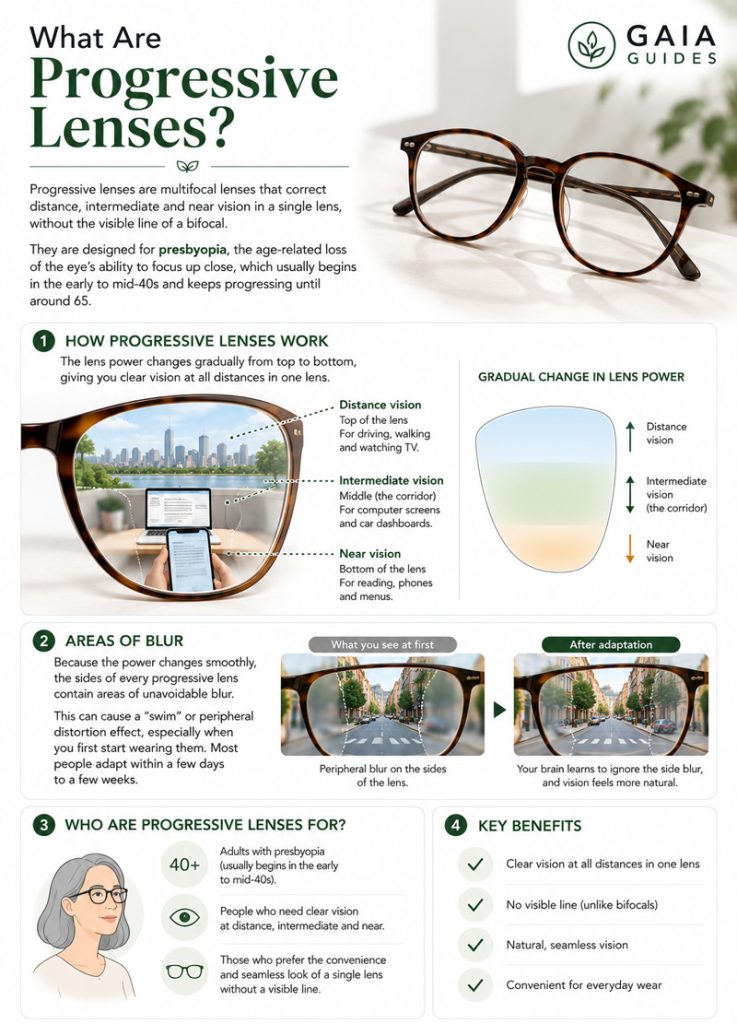
Because the power changes smoothly, the sides of every progressive lens contain areas of unavoidable blur. This causes the “swim” or peripheral distortion that some new wearers notice when they move their head. Premium designs shrink these zones and make them less noticeable, which is where much of the price difference comes from.
How Long Does It Take to Adjust to Progressive Lenses?
Most people adjust to progressive lenses within one to two weeks, though full comfort can take up to a month. During this time it is normal to notice:
- Slight blur or wavy edges when looking sideways
- A feeling of instability on stairs or kerbs, because you look through the near zone when you glance down
- Needing to turn your head, rather than just your eyes, to see clearly to the side
To adapt faster, wear your new glasses full-time and avoid switching back to your old pair. Point your nose at what you want to see, lower your chin slightly when reading, and take stairs carefully for the first few days. If dizziness, headaches or blur continue after three to four weeks, go back to your optician. The problem is often the fitting rather than the lens, and many shops offer adaptation guarantees for exactly this reason.
How We Compared the Best Progressive Lenses
We compared the main premium progressive lens ranges sold through Singapore optical shops on four criteria. Technology descriptions come from each manufacturer, so treat specific performance claims as marketing claims rather than independent test results.
Personalisation
How much of the design is calculated for you? Standard lenses use average values. Individualised lenses account for your frame, how it sits on your face, and in some cases how your eyes actually move and focus.
Width of clear zones
Wider distance, intermediate and near zones mean less head movement and less peripheral swim.
Ease of adaptation
Some designs prioritise a smooth, forgiving transition for first-time wearers. Others offer sharper zones but take longer to get used to.
Value and availability in Singapore
A lens is only useful if a skilled optician near you can measure and fit it properly.
The Best Progressive Lens Brands in Singapore (2026)
⭐ 1. ZEISS SmartLife Individual: Best for Distance Vision and Driving
Score: 9.3/10
ZEISS SmartLife is designed around how people use their eyes today, constantly switching between phones, screens and the world around them. The range starts with standard SmartLife and goes up to SmartLife Individual, the most customised version. ZEISS uses what it calls Smart Dynamic Optics for smoother transitions into the periphery, and Intelligence Augmented Design, which combines data on age-related visual behaviour with your own measurements. FaceFit and FrameFit+ technologies tailor the lens to your frame and how it sits on your face.
- Strengths: wide, stable distance zones, low peripheral distortion, excellent for driving and outdoor use
- Best for: drivers, active people and anyone sensitive to swim
- Watch for: top tiers are among the most expensive lenses on the market
⭐ 2. HOYA Hoyalux iD MySelf and MySense: Best for Screens and Near Work
Score: 9.1/10
HOYA’s Hoyalux iD range is popular in Asia and strong on comfort for close and intermediate work. MySelf uses Binocular Harmonization to balance the two eyes, 3D Binocular Vision to reduce the sway effect, and AdaptEase to ease the transition for wearers who are used to older lenses. MySense goes further, personalising the design based on measurements of your blur tolerance, focusing behaviour and posture using HOYA’s visuSense system.
- Strengths: comfortable reading and intermediate zones, good binocular balance, strong value at the premium level
- Best for: office workers, heavy screen users and readers
- Watch for: confirm which iD tiers your optician can supply in Singapore
Visio Optical’s detailed comparison of ZEISS Individual vs HOYA MySelf concludes that ZEISS edges ahead for distance and driving, while HOYA is stronger for near and intermediate work and offers better value.
⭐ 3. Essilor Varilux XR: Best for Fast Adaptation
Score: 8.9/10
Varilux invented the modern progressive lens in 1959 and remains one of the most widely prescribed brands. The Varilux range includes Comfort, Physio and the top-tier XR series. Essilor says XR uses behavioural AI developed from studying thousands of wearers, creating a visual behaviour profile for every prescription. In Essilor’s own studies, the vast majority of XR wearers reported adapting within the first day.
- Strengths: smooth, forgiving designs, widely available
- Best for: first-time progressive wearers and anyone who struggled with a previous pair
- Watch for: several Varilux tiers exist, so ask exactly which design you are being quoted
⭐ 4. Rodenstock B.I.G. EXACT: Most Precisely Individualised
Score: 8.7/10
German lens maker Rodenstock takes a biometric approach. A DNEye scanner measures your eyes in detail, and the lens is calculated using thousands of biometric data points rather than standard eye-model assumptions. Rodenstock argues that this gives sharper vision across the whole lens, particularly in low light.
- Strengths: highly individualised, strong for people with unusual prescriptions
- Best for: discerning wearers who want maximum precision
- Watch for: needs an optician with the right scanning equipment
⭐ 5. Nikon, Seiko and Shamir: Strong Alternatives
Score: 8.4/10
Several other manufacturers offer excellent progressive lenses that are often slightly better value:
- Nikon Presio: Nikon brings optical expertise from its camera business, with personalisation based on your prescription, frame and wearing position.
- Seiko Superior: Seiko’s custom-made progressive line is tailored to your face, frame and lifestyle, and its Japanese engineering suits Asian fittings well.
- Shamir Autograph Intelligence: matches one of multiple designs to your “visual age”, accounting for how focusing ability changes over time.
Comparison Table: Progressive Lens Brands
| Lens | Score | Key technology | Best for |
|---|---|---|---|
| ZEISS SmartLife Individual | 9.3 | Smart Dynamic Optics, FaceFit, FrameFit+ | Driving, distance, low swim |
| HOYA Hoyalux iD MySelf / MySense | 9.1 | Binocular Harmonization, 3D Binocular Vision | Screens, reading, value |
| Essilor Varilux XR | 8.9 | Behavioural AI design | First-time wearers, fast adaptation |
| Rodenstock B.I.G. EXACT | 8.7 | Biometric eye scanning | Maximum precision |
| Nikon / Seiko / Shamir | 8.4 | Personalised designs | Strong value alternatives |
How Much Do Progressive Lenses Cost in Singapore?
Prices vary widely depending on where you buy and which design you choose. These are typical ranges in 2026, based on published shop prices and consumer reports:
| Type | Typical price in Singapore | What you get |
|---|---|---|
| Budget chain progressive upgrade | About S$100–300 on top of the frame | Standard design, basic measurements |
| Branded mid-range progressive | About S$500–900 per pair | Better design, wider zones |
| Premium individualised progressive | About S$900–1,500+ per pair | Fully personalised design and fitting |
| Top-tier biometric or AI designs | Usually quote only | Most advanced personalisation |
These figures are indicative. Premium prices depend on your prescription, lens material, coatings such as anti-reflective and blue light filters, and whether the price includes the frame. Always ask for a written breakdown of the lens design, index and coatings so you can compare quotes properly.
Budget progressive lenses can work well for straightforward prescriptions, especially if you mainly need distance and reading. If you spend long hours on screens, drive a lot or have struggled with progressives before, a premium design is usually worth the extra cost.
Why the Fitting Matters as Much as the Lens
Even the best progressive lens will feel wrong if it is not measured and fitted correctly. A proper fitting should include:
- Pupillary distance (PD), measured for each eye separately, so the corridor lines up with your pupils
- Fitting height, the distance from your pupil to the bottom of the lens, which determines where each zone sits
- Vertex distance, how far the lens sits from your eye
- Pantoscopic tilt, the forward angle of the frame, typically around 7–12 degrees
- Frame wrap, how much the frame curves around your face
Individualised lenses use these measurements to calculate the lens specifically for you. If any of them are wrong, or if the frame slips down your nose, the zones end up in the wrong place and you get more blur and swim.
Choose the frame first
Frame choice matters. As a rule of thumb, progressive lenses need a frame with enough vertical depth, usually around 30mm or more, so there is room for all three zones. Very shallow frames can cut off part of the reading zone, although short-corridor designs are available. Frames with adjustable nose pads help keep the lens at the correct height. For many Asian faces with lower nose bridges, Asian-fit frames make a real difference to comfort and lens position.
💡 KEY INSIGHT
If your progressive glasses feel wrong after a few weeks, do not assume the lens is the problem. Ask your optician to recheck the fitting height, PD and frame adjustment first. Small fitting errors cause most progressive lens complaints.
Alternatives to Progressive Lenses
- Office or occupational lenses: designed for desk work with much wider intermediate and near zones. Lenses such as ZEISS Officelens cover distances from your book to the far side of a room. Many people keep a pair at work alongside their everyday progressives.
- Bifocals: two zones with a visible line. Less elegant but cheaper and easy to adapt to.
- Single-vision reading glasses: fine if you do not need any distance correction.
- Multifocal or monovision contact lenses: an option for people who prefer not to wear glasses.
Signs You May Need Progressive Lenses
Presbyopia creeps up gradually. You may be ready for progressive lenses if you notice any of these:
- Holding your phone or menus at arm’s length to read them
- Taking your glasses off to read, or pushing them onto your forehead
- Eye strain or headaches after reading or close work
- Needing brighter light to read small print
- Constantly switching between reading glasses and distance glasses
If you already wear glasses for distance, progressive lenses let you keep one pair on all day instead of juggling two. Starting progressives early, while your reading prescription is still mild, usually makes adaptation easier.
Progressive Lenses vs Bifocals vs Reading Glasses
| Progressive lenses | Bifocals | Reading glasses | |
|---|---|---|---|
| Zones | Distance, intermediate and near | Distance and near | Near only |
| Visible line | No | Yes | No |
| Computer distance | Yes, in a narrow corridor | No | Partly |
| Adaptation | One to four weeks | A few days | Immediate |
| Best for | All-day wear, one pair | Simple needs on a budget | Occasional reading only |
Lens Materials and Coatings Worth Paying For
The lens design is only part of the price. Materials and coatings make a noticeable difference to comfort, especially in Singapore’s bright, humid climate:
- High-index materials make lenses thinner and lighter for stronger prescriptions. For mild prescriptions, standard index is usually fine.
- Anti-reflective coatings reduce glare from screens and headlights and make your eyes more visible to others. Premium coatings also resist smudges and scratches.
- Blue light filters are popular for screen users. They reduce a portion of blue light, although evidence that they prevent eye disease is limited.
- Photochromic lenses such as Transitions darken outdoors, so one pair works indoors and outside.
- Prescription sunglasses with progressive lenses are useful for driving and golf in strong tropical sunlight.
Progressive Lenses for Different Lifestyles
Drivers
Look for designs with wide, stable distance zones and good contrast in low light. Some brands offer driving-specific lenses that reduce glare from oncoming headlights at night.
Office workers
Your eyes spend most of the day at screen distance, which is the narrowest part of a progressive lens. A design with a wider intermediate zone, or a dedicated office lens for work, will be much more comfortable.
Active and outdoor lifestyles
Golfers, cyclists and walkers benefit from designs that minimise peripheral swim, plus photochromic or tinted lenses. Sports frames with wrap need lenses calculated for that curve.
Fashion-conscious wearers
If you want a striking designer frame, choose it with your optician before ordering lenses. Individualised lenses can be calculated for the specific shape and position of the frame, so you do not have to compromise on style.
Common Progressive Lens Problems and How to Fix Them
| Problem | Likely cause | What to do |
|---|---|---|
| Blurry reading zone, need to tilt head back | Fitting height too high or frame sitting low | Ask for the nose pads or frame to be adjusted, or the height remeasured |
| Narrow, tunnel-like vision | Basic design or short corridor in a shallow frame | Consider a premium design or a deeper frame |
| Dizziness or swimming sensation | Peripheral distortion, wrong PD or tilt | Give it two weeks, then have measurements checked |
| Computer screen blurry | Screen sits too high for the intermediate zone | Lower the monitor or add an office lens |
| One eye clearer than the other | Monocular PD or prescription error | Return for a recheck of measurements and prescription |
Most of these problems are fixable. A good optician will adjust the frame, recheck measurements, or remake the lenses if necessary. This is one of the strongest arguments for buying progressives from a shop that offers proper aftercare, rather than choosing on price alone.
How to Care for Progressive Lenses
- Rinse lenses with water before wiping to remove grit that can scratch coatings
- Clean with a microfibre cloth and lens spray, not tissues or clothing
- Avoid leaving glasses in a hot car, which can damage coatings
- Store them in a hard case, and never place them lens-down
- Have the frame adjusted every few months, because a frame that slips changes where you look through the lens
Regular frame adjustments are free or inexpensive at most opticians and help keep your progressive zones in the right place.
How to Choose the Best Progressive Lenses for You
- Think about your day. If you drive a lot, prioritise wide distance zones. If you work at a computer, prioritise intermediate width, or add an office lens.
- Be honest about past experience. If you struggled with progressives before, choose a design known for easy adaptation and insist on a careful fitting.
- Ask what is personalised. “Individual” or “personalised” can mean very different things. Ask which measurements are used.
- Compare like for like. Check lens index, coatings and warranty, not just the brand name.
- Check the adaptation policy. A good optician will remake or adjust lenses if you cannot get used to them within a set period.
Where to Buy Progressive Lenses in Singapore
You can get progressive lenses at budget chains, department store opticians and independent optical boutiques. Chains are convenient and affordable for simple prescriptions. Independent opticians typically spend more time on measurements and stock a wider choice of premium lens brands.
Visio Optical in Holland Village is one example of an independent optician that supplies ZEISS, HOYA, Rodenstock, Essilor, Nikon, Seiko and Shamir lenses, with an optometrist on duty for a full eye examination before fitting. If you are deciding where to go, our guide to choosing the best optical shop in Singapore covers what to look for.
Conclusion: Invest in the Lens and the Fitting
The best progressive lenses in Singapore depend on how you live and work. ZEISS SmartLife Individual is the strongest all-rounder for distance and driving, HOYA iD MySelf and MySense excel for screens and value, Varilux XR is a safe choice for easy adaptation, and Rodenstock B.I.G. EXACT offers the most precise individualisation.
Whichever brand you choose, the fitting is what turns a good lens into a comfortable pair of glasses. Start with a proper eye test, choose a suitable frame, insist on careful measurements, and give yourself two to four weeks to adapt.
More eyewear guides from Gaia Guides
- Best Optical Shops in Singapore (2026)
- Lindberg Glasses Singapore: Prices & Where to Buy
- Custom Made Glasses in Singapore: Bespoke Eyewear Guide
- Myopia Control for Kids in Singapore
- Best Japanese Eyewear Brands & Where to Buy in Singapore
Frequently Asked Questions
1. What are the best progressive lenses in Singapore?
ZEISS SmartLife Individual, HOYA Hoyalux iD MySelf or MySense, Essilor Varilux XR and Rodenstock B.I.G. EXACT are the leading premium options. The best choice depends on whether you prioritise distance, screen work or easy adaptation.
2. How much do progressive lenses cost in Singapore?
Budget options start at about S$100–300 on top of the frame. Branded mid-range progressives typically cost about S$500–900, and premium individualised lenses can exceed S$1,500 a pair.
3. Why do my progressive lenses feel blurry at the sides?
Every progressive lens has blur zones at the edges. Premium designs reduce them. If the blur is severe or does not improve after a few weeks, the fitting may need adjusting.
4. Can I use progressive lenses for computer work?
Yes, but the intermediate zone is narrow. If you spend long hours at a screen, an office lens as a second pair is often more comfortable.
5. Are progressive lenses suitable for first-time wearers?
Yes. Most first-time wearers adapt within one to two weeks, especially if they start progressives early, before their reading prescription becomes strong.
6. How often should I replace progressive lenses?
Usually every one to two years, or whenever your prescription changes. Presbyopia tends to increase until your mid-60s.
A Note from Gaia Guides
Needing progressive lenses is a normal part of life after 40, not a sign that your eyes are failing. The difference between a frustrating pair and one you forget you are wearing usually comes down to the design and, above all, the care taken during fitting. Take the time to choose a skilled optician, and do not settle for lenses that still feel wrong after a month.
Experts You Can Trust
✓ Evidence-Based & Fact-Checked. Last updated October 2026. This article draws on information from lens manufacturers, Singapore eye research and published optometry guidance. Brand technology descriptions are manufacturers’ claims. This article is educational and not a substitute for a professional eye examination.
Sources & References: